
Register now free-of-charge to explore this white paper
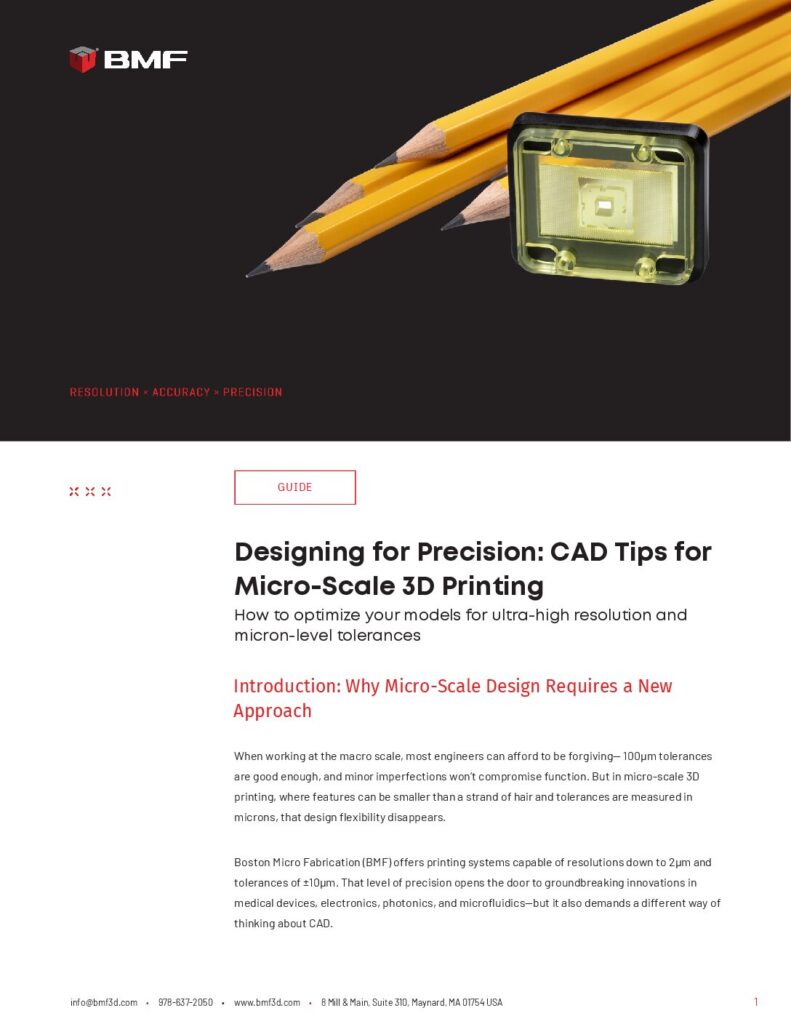
This Whitepaper provides engineers and scientists with practical guidance on optimizing CAD models for micro-scale 3D printing — helping you achieve ultra-high resolution and micron-level tolerances across a range of demanding applications.
What you will learn about:
- How to set realistic tolerances and match feature sizes to your printer’s resolution capabilities
- Best practices for wall thickness, reinforcement features, and part orientation to ensure structural integrity at the micro scale
- Strategies for managing undercuts, overhangs, and supports without compromising delicate features
- Key microfluidic channel design considerations including sizing, aspect ratios, cleanability, and flow optimization
- How to select the right material for your application and configure CAD exports for micro-precision printing
Click ‘LOOK INSIDE’ to Download Now.
IEEE Spectrum and Wiley are proud to bring you this white paper, sponsored by Boston Micro Fabrication.
More Information
Micro-scale 3D printing demands a fundamentally different approach to CAD design compared to traditional macro-scale work. With feature sizes smaller than a strand of hair and tolerances measured in single-digit microns, the margin for error is virtually zero. Engineers working in medical devices, electronics, photonics, and microfluidics need to rethink how they handle tolerances, geometry, wall thickness, and support structures when designing at this scale. This whitepaper walks through practical, field-tested tips — from setting appropriate tolerances and reinforcing thin walls to designing functional microfluidic channels and choosing the right materials — so you can reduce failed prints, shorten iteration cycles, and move from concept to validated prototype with confidence.
Sponsored by

Partnered with

IEEE Spectrum Magazine, the flagship publication of the IEEE, explores the development, applications and implications of new technologies. It anticipates trends in engineering, science, and technology, and provides a forum for understanding, discussion and leadership in these areas.